What is Personal Selling?
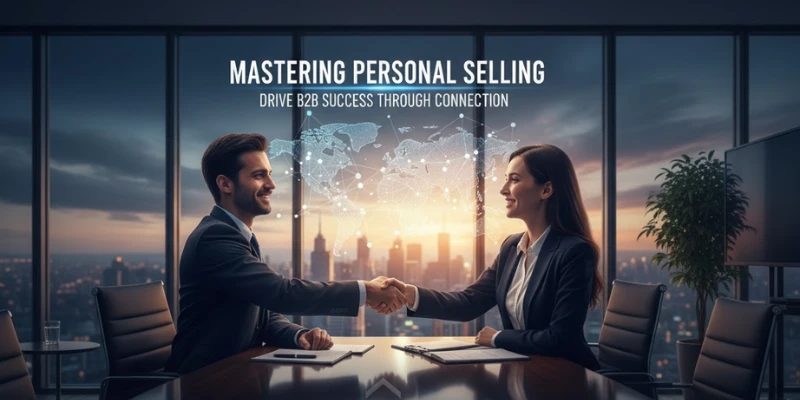
Personal selling is the process where the salesperson directly communicates with the potential sales prospect in person for the purpose of making them buy their product or service. This process is crucial in B2B sales environments, where personalized approaches in inside sales teams make a significant impact. It includes the process of two-way communication where the salesperson makes tailored presentations, clarifies the doubts of the customers on the spot, and develops long-term, sturdy relationships, which is important for effective customer management.
Why Does Personal Selling Matter In Modern Businesses?
Personal selling is relevant to contemporary business because it develops solid clientele connections, establishes trust, and generates reliability by way of direct, individualized contact, resulting in higher sales and return business. In B2B sales and inside sales, personal selling allows for the ability to give individual attention, tailor-make for individual customers, confront worries directly, and obtain a purchase commitment more successfully than non-personal contacts. Successful sales strategies rely heavily on personal selling to nurture sales prospects and sales leads and convert them into loyal customers. Balancing sales prospecting efforts is critical to maintaining a steady pipeline of sales leads for sustained growth.
The Process of Personal Selling
The following are the steps involved in personal selling:
Sales Prospecting and Qualifying
Sales prospecting and qualifying are the first and most important steps in the process of personal selling. In this step, the salesperson finds out about potential sales leads, which is a critical phase in sales prospecting for generating high-quality, qualified sales leads. Subsequently, the role of the specialized sales support team is to determine whether they fit or have the need, budget, and authority to buy the product or service (qualifying). Organizations that excel in sales prospecting find their sales lead pipeline continuously replenished in the sales cycle.
Preparation and pre-approach
Preparation and pre-approach are integrated, planning-oriented phases in the process of selling where a salesperson investigates a sales prospect, learns about their needs and history, and tailors a B2B sales approach and presentation to establish rapport in customer management. Effective sales support teams back up this phase by providing relevant data and resources to the salesperson. Efficient sales prospecting leads directly to more productive presentations and a shorter sales cycle.
Presentation and demonstration
Presentation and demonstration are essential phases in personal selling where the sales support teams present a product or service, disclosing its attributes and advantages to an identified sales prospect and illustrating how it addresses their particular needs. In SaaS sales and inside sales, this phase is used to accentuate the value of the product, create interest, and support the customer management to interact in order to spur a buying decision, using personalized approaches that are core to efficient inside sales operations in the sales cycle.
Handling objections
Objection handling is a key and strategic component of the personal selling process, especially in inside sales. It is not one of the distinct sales strategies in the sales cycle, but an important skill employed to overcome sales prospecting issues, eliminate misunderstandings, show value, and finally establish trust and close deals in B2B sales. Objection handling includes active listening, empathy, acknowledgment of specific concerns, and assurance of satisfaction to lead the sales prospect towards successful SaaS sales transactions.
Closing the sale
Closing the sale is not only the final step in the sales cycle, but an essential step where the salesperson invites the customer to buy, converting them from a sales prospect into a buyer by means of an agreement, such as a signed contract or payment. For inside sales and SaaS sales, strong sales strategies at this stage ensure smooth transitions and maximize conversion rates. Moreover, a strong sales support ensures all contractual and transactional needs are met at this stage.
Post-sale follow-up
Follow-up after sale is the last but critical step where a salesperson maintains a healthy customer management and keeps contact with a recently acquired customer to develop a long-term relationship, confirm satisfaction of the customer, and generate future income in the form of repeat purchases and word-of-mouth referrals. Effective customer management after the sale strengthens brand loyalty and encourages referrals, essential in both B2B sales and direct personal selling. Follow-up in inside sales instances reinforces value, supports ongoing SaaS sales, and promotes referrals for new sales leads. Continuous sales support assists in maintaining high customer satisfaction and extends the life of the sales cycle.
Types of Personal Selling
Different types of personal selling include:
Transactional Selling
Transactional selling is actually a form of personal selling geared towards making individual, one-off sales quickly and easily, frequently for inexpensive products, where the buyer has enough information to make a decision immediately.
Consultative Selling
Consultative selling is a personal selling in which the salesperson plays the role of a trusted consultant, with an emphasis on knowing a customer’s problem and requirement before prescribing a customized solution. Rather than pushing a product aggressively in SaaS sales, consultative sellers establish a trusting relationship by way of active listening, questioning, and giving expert advice to enable the customer to realize their objectives.
Relationship Selling
Relationship selling entails one-on-one, face-to-face contact between a customer and a salesperson. Although personal selling generally refers to any direct seller-buyer interaction, customer management seeks to build long-term rapport and trust with the sales leads in B2B sales.
Social Selling
Social selling is a contemporary form of personal selling and a sales prospecting technique that utilizes social media to establish relationships, identify sales prospects, foster sales conversations, and enhance customer management. Rather than direct pitches towards the sales leads in B2B sales, social selling emphasizes value creation through content, sales prospect engagement, and becoming a trusted industry expert to generate conversions and sales in a more organic, personalized manner.
Solution Selling
Solution selling is a form of personal selling, defined by a customer-oriented approach aimed at finding and fixing a sales lead’s issue and not merely promoting a product. Solution-selling salespeople are more advisers, delving deep into customer pain and needs to suggest products, services, or approaches that bring actual value and deliver desired results to strengthen customer management in B2B sales or SaaS sales.
Strategic Selling
Strategic Selling is a one-on-one, customized approach to selling with an emphasis on learning the specific needs of the sales leads in order to establish a long-term relationship and review customer management. It places heavy emphasis on intensive research, addressing multiple stakeholders, and positioning the salesperson as a long-term partner in co-creating solutions, making it a strategic, relationship-based type of personal selling in B2B sales.
Benefits of Personal Selling for Businesses
Mentioned are some ways in which personal selling can benefit businesses.
Stronger customer relationships
Personal selling deepens customer relationships by building trust through personal, customized interactions, solving concerns in real-time, and offering customized solutions. This results in higher customer loyalty, greater customer lifetime value (CLV), and greater repeat purchases and positive word-of-mouth referrals, all of which drive sustainable business expansion and customer management effectiveness.
Higher conversion rates
Personal selling in inside sales and B2B sales yields increased conversion rates due to its customized, face-to-face encounters, creating trust, solving personal customer needs using personalized pitches, and offering on-the-spot, real-time feedback, resulting in more efficient sales processes and higher customer satisfaction. It also results in successful customer management.
Feedback and market insights
Two-way personal interaction is the most important advantage of personal selling since the direct two-way interaction between a customer and a salesperson enables real-time customer feedback, which can be used to improve products and marketing strategies. These sales strategies in direct personal interaction also offer valuable market information, such as learning the needs and habits of the customers.
Brand reputation and trust
Personal selling builds brand reputation and credibility through establishing solid, long-term customer relationships by direct contact with sales leads, which increases loyalty, stimulates word-of-mouth promotion, and results in greater customer management and confidence and repeat purchases in B2B sales, inside sales, and also SaaS sales.
Challenges in Personal Selling
The challenges in personal selling include:
High costs and time investment
For a company or during B2B sales, the expense and time commitment of personal selling are a significant obstacle. Although good for expensive and sophisticated products, the resources required can be budget-stretching and scalable limiting in contrast to less resource-intensive marketing channels.
Dependence on the salesperson’s skills
Reliance on salespeople’s ability creates serious challenges for personal selling, resulting in unreliable performance, susceptibility, high expense, and lack of scalability. Salesperson expertise profoundly affects outcomes in B2B sales, inside sales, and sales support.
Difficulty scaling compared to digital methods
Scaling personal selling is inherently challenging in comparison to online methods because it relies on human resources that are scarce, expensive, and unpredictable. Scaling high-touch personal selling, especially across many sales leads, is more complex than digital approaches.
Final Thoughts
Personal selling will flourish in the digital era through the combination of human touch and technology, leveraging AI and automation to process mundane tasks, and embracing hybrid and remote selling models. Sellers of the future will employ digital tools and better sales strategies for research and personalization, prioritize trust and relationship building in virtual spaces, and use hybrid models that integrate digital interaction with face-to-face interaction when necessary.
Personal selling stands out for using human interaction to generate B2B sales, inside sales, and SaaS sales. Although direct communication is one of the effective sales strategies in personal selling to facilitate interaction and closing, it is still a significant weapon, particularly for sophisticated products, in building enduring relationships with customers in a highly competitive B2B sales world.