
A sales pipeline is a diagram that illustrates the customer experience throughout the sales process, deconstructing each step from lead to closed customer. Knowledge of the stages of a sales pipeline is crucial for efficiently managing and advancing sales. This article discusses the basic stages of a sales pipeline, along with integrating the top concepts like lead qualification process, prospecting, lead nurturing stages, and sales funnel stages, and some of the best practices in pipeline management and pipeline forecasting to strengthen overall sales and marketing alignment.
What is a Sales Pipeline?
A sales pipeline is a visual representation of the path the customer takes through the sales process, with each sales pipeline step from lead to closed customer defined. The stages of a sales pipeline help track prospects, identify next steps, watch out for bottlenecks, and forecast anticipated deals by breaking the process down into trackable, tangible steps. Common sales pipeline stages would be prospecting, lead qualification process, proposal, commitment, and closing, with the specific stages varying with industry. Knowing the stages of a sales pipeline allows for improved focus and control throughout the sales journey. This clarity also supports better sales and marketing alignment by ensuring both teams understand where each prospect currently stands.
Sales Pipeline vs. Sales Funnel
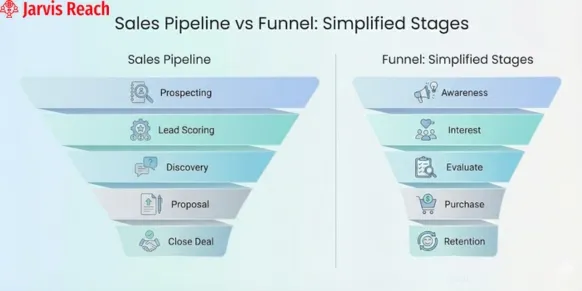
Sales pipeline steps follow a seller’s action and steps to advance a deal along stages, whereas a sales funnel stages illustrate the buyer’s process from awareness to purchase. The pipeline emphasizes what the sales team does to move prospects forward, and the sales funnel stages show how many potential buyers are present at each customer journey stage.
Both concepts are vital to understanding comprehensive sales success in the b2b sales pipeline, enhancing the lead nurturing stages. They also play a major role in improving sales and marketing alignment across the customer journey. Sales funnel stages outline the customer’s path from becoming aware of a product or service to purchasing and becoming a repeat customer. Common funnel stages include Awareness, Interest/Consideration, Decision, Action, and Retention/Loyalty.
Stages of a Sales Pipeline
To build a sales pipeline, BB sales companies should follow the structured stages of a sales pipeline. The mentioned sales pipeline steps will guide you to build a stage pipeline.
1. Prospecting and Lead Generation
Prospecting and lead generation are the starting, early stages of a sales pipeline in which salespeople proactively find and draw in prospects who have a good likelihood of being interested in their services or products. Lead generation seeks to generate interest and a pipeline of potential customers through various marketing and sales endeavors, whereas prospecting seeks to find opportunities and individuals. Typical activities include networking, cold outreach, content marketing, and targeted advertising. These early outreach activities require strong sales and marketing alignment to ensure consistent messaging and targeting.
2. Lead Qualification Process
Not every possible customer is going to close. And that’s where the lead qualification process fits in and is one of the important stages of a sales pipeline.
To start with the sales pipeline steps, a baseline of lead qualification process, a well-defined qualification framework, enhances sales and marketing alignment, ensuring both teams agree on what a qualified lead looks like. Such as leads in a certain geographic area or industry, will need to be established. Most CRMs will also allow you to set these and automatically score leads, so you don’t have to manually review leads. Qualify leads who pass your set criteria with a lead qualification call. A proper lead qualification process refines the sales pipeline to focus on the most promising prospects.
3. Initial Contact and Discovery
Initial Contact in the sales pipeline steps is when you initially contact a qualified lead to initiate a connection and start the conversation, whereas Discovery is the next sales pipeline step centered on learning about the lead’s particular challenges, objectives, and requirements to ascertain how your solution may assist them. They are key initial steps to creating rapport, qualifying further, and customizing a future sales strategy in these pipeline management steps.
4. Product Demo
A product demo is a separate sales pipeline step that most often occurs after a lead has been qualified and prior to the proposal stage, in which a salesperson illustrates how the product addresses a particular customer’s pain point. An interactive session presenting potential customers with a concrete experience of the product and emphasizing its value and benefits to establish trust and illustrate a compelling business case for a buy.
5. Proposal
In the stages of a sales pipeline, the proposal stage is where a salesperson makes a customized offer to a qualified prospect with a description of how the product or service addresses their particular issues and delivers value. This stage comes after needs assessment and precedes negotiation and closing, being an official sales offer that specifies price, terms, and the differentiated value proposition to get the prospect closer to buying.
6. Negotiation and Objection Handling
In the stages of the sales pipeline, negotiation is the pivotal step where the seller and prospect negotiate the terms, conditions, and price of the deal to agree upon a mutually acceptable deal before the sale is completed. It happens after the prospect believes the value of the product or service, normally after a proposal or demo, and is used to eliminate any outstanding objections or concerns to close the deal and make progress toward closing. It resolves outstanding objections through strategic responses, a skill that occurs across multiple lead nurturing stages, to move the deal toward closing.
Objection handling isn’t a part of the stages of the sales pipeline or a sales pipeline step, but a critical skill and procedure that occurs within multiple steps of the sales process, ranging from initial prospecting to close. Effective objection handling is the process of listening attentively to the objections of a prospect, confirming and validating them, and then responding with tailor-made information to overcome the objections and advance the sale.
7. Closing the Deal
In the stages of a sales pipeline, “Closing the Deal” is the last sales pipeline step where a prospect officially becomes a customer upon agreement of terms and signing of a contract or payment. Many teams finalize this step using digital signing tools like Contraxly, which helps streamline the contract approval process. It comes after effective negotiation and entails dealing with any last legal or financial formalities to close the sale and pave the way for post-purchase activities such as onboarding.
8. Post-Sale Lead Nurturing
Post-sales lead nurturing stages are tactical processes of ongoing interactions with customers following a purchase to build loyalty, maximize lifetime value, and foster repeat business, ultimately closing the gap between “selling” and “succeeding”. Post-sale lead nurturing stages are often part of a well-managed b2b sales pipeline and include continuous engagement beyond the initial transaction.
Importance of a Sales Pipeline
Every B2B sales company that is looking to build up a sales pipeline for their seamless journey and growth in the market follows a structured format. But have you ever wondered why there is a need for this sales pipeline? Sales pipeline not only provides you with the sales insights or leads, but it also holds the team accountable and prevents it from falling into the cracks.
– Why Every B2B Sales Team Needs a Structured Pipeline
All B2B sales teams require a B2B sales pipeline as it offers insights into the stages of a sales pipeline, allowing for effective pipeline forecasting, streamlined lead management, high-value deal prioritization, better team accountability, and stronger pipeline management. The pipeline will identify bottlenecks, maximize sales strategies, and prevent deals from falling through the cracks, leading eventually to more predictable and higher revenue growth in the pipeline management.
– Increasing Forecasting Accuracy (Pipeline Forecasting)
A reliable pipeline forecasting is dependent on the stages of a sales pipeline since it gives a picture of the sales cycle, so that organizations can accurately predict future revenues by qualifying deals with probabilities and pinpointing the clogs. It enables organizations to make better decisions based on facts, invest resources efficiently, and set realistic expectations.
– Enhancing the Customer Journey Stages
A sales pipeline improves the customer journey stages by providing details of the stage of each prospect, enabling one-on-one communication, highest efficiency, and offering data-driven insights to automate the sales process. The structured follow-up of the stages of a sales pipeline prevents lead forgetting, enables timely and relevant follow-ups, and enables the sales team to identify and eliminate roadblocks, thereby optimizing customer experience and revenue.
– Maximizing Conversion Rates via Better Lead Nurturing
A sales pipeline is crucial in propelling conversion rates through the enhanced lead nurturing stage since it provides an organized means to propel potential customers through the selling journey, with the proper communication and supply of appropriate content at the right moment. With an image of where every lead is, sales teams can focus on high-priority leads, build trust and credibility through focused contact, and thereby optimize the process to convert more qualified leads into loyal customers.
FAQs
1. What are the 5 stages of the sales pipeline?
The stages in the sales funnel are generally made up of prospecting, lead generation, qualifying leads/leads and engaging (contacting leads) leads, nurturing (relationship building), conversion (or closing), implementation, and onboarding. The last two steps are usually more applicable to B2B2C companies. Additionally, you would usually follow up with cold leads.
2. What are the 4 pipeline stages?
The pipeline image to the right shows a graphical view of a pipeline ({process}) of four steps (fetch, decode, execute, write back) sample generic view of a pipeline.
3. What is the 7-stage sales process?
There are seven common steps to the selling process: prospecting, preparation, approach, presentation, objection handling, closing, and follow-up.
4. What is the 10-3-1 rule in sales?
The rule of thumb 10-3-1 in sales, in my case advisory, is – 10 opportunities get you 3 proposals, and those 3 proposals get you 1 opportunity completed successfully.
Final Thoughts
The stages of a sales pipeline allow the buyer’s journey to be visualized, enabling more effective management and forecasting. It needs to have an ongoing, standard process of sales pipeline steps, such as prospecting and closing, and needs to be managed proactively by keeping it full, advancing deals, and regularly inspecting for bottlenecks and performance improvement. Structuring information and automating tasks using CRM tools is crucial for productivity, and bringing the pipeline in line with buyer needs guarantees a smooth customer journey.
The stages of a sales pipeline provide valuable visibility into the buyer’s journey and help sales teams manage and forecast sales more effectively. A successful pipeline requires ongoing effort to populate it with quality leads, execute the lead qualification process rigorously, tailor messaging to prospects, and leverage CRM tools for pipeline management.

