

Winning new B2B clients is harder than ever. Buyers are informed, sales cycles have lengthened, and trust matters more than quick wins. That is why client acquisition is no longer about chasing leads.
Rather, it’s about creating a repeatable data-driven system to attract the right businesses and ultimately turn interest into revenue.
B2B client acquisition doesn’t have to be complicated-here’s a straightforward guide with examples and steps to follow.
What is Client Acquisition in B2B?
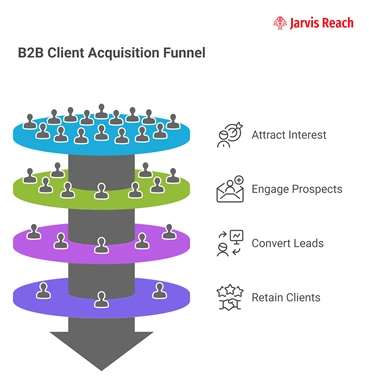
Client acquisition is the process of attracting, engaging, and converting a new client base for a business.
In the B2B environment, it will be the acquiring of other companies rather than consumers directly. Reaching them through the right channels and building trust through value-based communication.
It includes every step from first touchpoint to signed contract:
- Identifying ideal business prospects
- Reaching them through the right channels
- Building trust through value-based communication
- Converting them into paying clients
The client acquisition meaning in B2B goes beyond lead generation. It involves relationship-building, multiple decision-makers, and longer buying cycles.
In simple terms, the client acquisition definition is the structured approach businesses use to consistently bring in qualified clients who fit their services or products.
Core Elements of a B2B Client Acquisition System
A strong client acquisition system makes growth predictable and not random. These are the essential elements every B2B company needs.
- Clear Ideal Client Profile
Effective acquisition client targeting starts with knowing who you want.
- Industry and Company size
- Budget range
- Pain points and buying triggers
Without ICPs clarity, even strong marketing efforts fall flat.
- Value-Driven Messaging
B2B buyers respond to outcomes, not hype.
- Focus on efficiency, cost savings, or revenue impact
- Use data, case studies, proof points
This forms one of the fundamental pillars of successful customer acquisition marketing.
- Lead Generation Channels
A system combines many channels like:
- Content and SEO
- LinkedIn outreach
- Email campaigns
- Paid acquisition marketing
Risk increases with dependence on one channel.
- Sales Alignment
Marketing brings interest. Sales closes deals. Both must align on:
- Lead qualification criteria
- Messaging consistency
- Follow-up timelines
Proven B2B Client Acquisition Strategies That Work
There is no one-size-fits-all approach, but these client acquisition strategies are proven across industries. A strong B2B acquisition strategy combines multiple channels and tactics to reach prospects, nurture leads, and convert them efficiently.
- Content Marketing
High-value content such as blogs, whitepapers, eBooks, and case studies attracts high-intent buyers. Content demonstrates expertise, builds trust, and nurtures prospects over longer B2B sales cycles. A good client acquisition strategy usually places content at the center of most lead generation and brand authority efforts.
- SEO (Search Engine Optimization)
Optimizing your website and content for search engines helps potential clients find you organically. SEO-driven customer acquisition increases visibility, drives targeted traffic, and reduces reliance on paid channels over time. This includes on-page SEO, backlink building, and technical SEO to ensure search engines can crawl and rank your pages effectively.
- Digital Advertising
Paid channels include Google Ads, LinkedIn Ads, and retargeting campaigns that give vendors instant visibility in front of decision-makers. Set up targeted digital advertising with engaging landing pages and offers to significantly increase lead conversion, while maintaining tracking of the client acquisition cost for improved ROI.
- Social Media Marketing
Platforms like LinkedIn, Twitter, and industry-specific forums allow B2B companies to reach, engage, and build relationships with potential clients. Sharing thought leadership, case studies, and success stories helps in positioning your business as an authority in your field.
- Email Marketing
Email remains a highly effective tool for B2B client acquisition. Personalized campaigns, lead nurturing sequences, and automated follow-ups ensure prospects move smoothly through the sales funnel. If integrated with CRM, email marketing allows enhanced tracking and better conversion of leads.
- Outbound Prospecting
Targeted outreach via personalized emails, LinkedIn messages, and cold calls can accelerate customer acquisition when done thoughtfully. Avoid generic pitches; focus on prospects’ pain points and demonstrate clear value.
- Referrals
Referral programs leverage existing clients or partners to bring in new business. These leads are often high-quality and convert faster, reducing client acquisition cost while strengthening credibility.
- Great Service
Exceptional service not only retains clients but also fuels organic growth. Satisfied clients become advocates, leaving positive reviews and referring new leads. In B2B, reputation and results often outweigh flashy marketing campaigns.
- Marketing Automation
Automation tools streamline follow-ups, lead scoring, and workflow management. This ensures consistent engagement without overloading sales teams, making the client acquisition system more scalable and efficient.
Why Client Acquisition Is Essential for B2B Companies
Without a reliable client acquisition strategy, growth becomes unpredictable.
Here is why it matters:
- Revenue stability depends on a steady pipeline
- Market conditions change, clients churn, and competition grows
- A scalable system reduces dependency on referrals alone
B2B companies with structured client acquisition strategies are better positioned to forecast revenue, allocate budgets, and expand into new markets.
Key Obstacles B2B Companies Face in Client Acquisition
Even strong businesses struggle with bringing in clients. Common challenges include:
- Long Sales Cycles
Multiple stakeholders’ slow decisions and increase drop-offs.
- High Competition
Similar services compete on price instead of value, increasing client acquisition cost.
- Poor Lead Quality
Volume without qualification wastes sales time and inflates costs.
- Unclear Cost Tracking
Many teams fail to calculate true acquisition spend using a proper client acquisition cost formula.
Use this formula:
CAC = Total Sales + Marketing Expenses ÷ Number of New Clients Acquired
Example: If you spend $50,000 on marketing and sales and gain 10 new clients, your CAC is $5,000 per client.
Tracking this metric is essential for sustainable growth.
Conclusion
B2B growth depends on more than effort. It depends on structure. A solid customer acquisition strategy brings together clear targeting, value-driven messaging, reliable channels, and tracking of cost. Guesswork decreases and conversion rates rise when businesses invest in a scalable client acquisition system to ensure long-term stability in revenue.
It is not merely about more leads. It is better clients, acquired consistently.
FAQs
- What is the Customer Acquisition Cost (CAC)?
Customer acquisition cost is the amount spent by the business to acquire a new client. This includes marketing and sales expenses and all related costs.
- Where to find agencies specializing in client acquisition services?
You can find specialized agencies through LinkedIn, industry directories, B2B marketing platforms, and referrals from similar businesses in your niche.
- Best software for automating client acquisition workflows?
Some of the popular tools include HubSpot, ActiveCampaign, Jarvis Reach, and Marketo. This support automating email, CRM, and lead scoring on their platforms.
- Top CRM platforms for managing new client leads?
Salesforce, HubSpot CRM, Zoho CRM, and Pipedrive are widely used for managing B2B leads and pipelines.
- Best digital marketing tools for client acquisition?
Effective tools include Google Ads, LinkedIn Ads, SEMrush, Ahrefs, and email outreach platforms that support acquisition marketing campaigns.

