
In a world that has more interest in social media and automation than real human connection, B2B Email Marketing remains quietly one of the most effective means of advancing your business. It’s personal, it’s scalable, it’s measurable, and it has one of the highest ROI ratios in the history of marketing. For clients looking to contact real decision-makers, B2B Email Marketing provides something that few channels can: the chance for direct contact, building trust, and potential for always-on conversion of target customers.
B2B Email Marketing is not B2C marketing, targeting impulse-ridden consumers; it is longer-term and rational value-based. It is sending the right content to the right people at the right time. If implemented correctly, it helps increase sales, improves the performance of email analytics, and outbound marketing becomes an engine driven by precision.
Let’s break down how modern B2B Email Marketing works, what defines successful campaigns, and how you can leverage AI, data, and automation to build B2B Email Marketing strategies that actually convert.
What Is B2B Email Marketing?
B2B Email Marketing is when businesses send emails to other businesses, with the objective of respectively, creating a partnership, sharing service offerings, or nurturing inquiry prospects. It isn’t just about sales; it’s about identifying challenges, providing insights, and building authority in your content.
Essentially, in its purest form, B2B Email Marketing is the art and science of communicating with businesses through email. It uses B2B data, marketing data to reach specific decision-makers. AI tools have become instrumental in assisting brands with determining engagement patterns, predicting response rates, and refining drip email campaigns to deliver better timing and content efficacy.
Characteristics:
• Highly targeted: Based on firmographics, business type, and buyer persona.
• Driven by data: Based on clean B2B data and verified marketing data.
• Relationship-driven: Focus on trust, value, and frequency.
• Long-cycle nurturing: Created for longer, multi-step decision making.
• Measurable: Driven by detailed email analytics to inform performance changes.
Welcome emails, newsletters, educational drip emails, product updates, and re-engagement emails are examples of common B2B Email Campaigns that can be constructed to increase sales and maintain presence in the inboxes of an Academy team that is often flooded with messaging.
Key Features of B2B Email Marketing in Today’s World
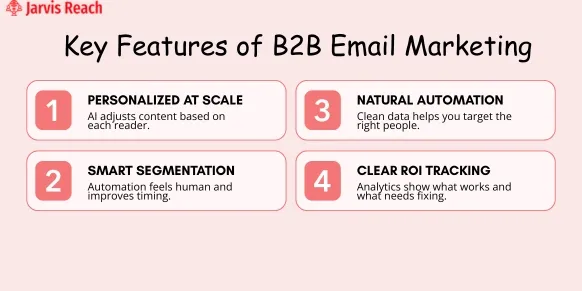
B2B Email marketing today and their campaigns have varying capabilities. AI has changed the prospect of timing, content, and list management.
1. Personalized at Scale
Thanks to automation, personalization now goes beyond a first name. As an example, AI tools will examine email analytics and marketing data to serve up content that is influenced by the reader’s behavior. Drip email campaigns base each email around individual needs and stages of the buyer’s journey.
2. Data-Driven Segmentation
The basis of good segmentation begins with good B2B data. Clean b2b email lists allow for minimizing spam traps, improving deliverability, and ensuring every outbound marketing message for potential clients reaches the right inbox.
3. Human-Like Automation
AI doesn’t replace human creativity; it amplifies it. Starting from send time predictions to CTA optimizations, automation helps businesses get their B2B Email Marketing strategies right while remaining very human and relatable in tone.
4. ROI-Focused Measurement
Email analytics tracking for opens, conversions, and CTRs allows marketers to understand which messages increase sales and which messages need to be revisited. Being able to measure every action lends a level of precision found nowhere else in outbound marketing.
Types of B2B Email Campaigns That Drive Results
1. Welcome and Onboarding Campaigns
The moment someone joins your B2B email lists, your brand’s tone is set. A friendly welcome sequence introduces your business, showcases value, and builds credibility. Personalized welcome messages often have the highest email analytics engagement rates.
2. Drip Email Campaigns
These are an automated series of messages sent at regular intervals. A good drip email campaign creates a lead nurturing process with time, builds familiarity, and helps increase sales without being pushy. Each email provides value, a case study, a tip, or an industry insight designed to move the reader closer to action.
3. Cold Email Outreach
Cold emails remain a pillar of outbound marketing. When done right, they’re not spam, they’re strategic introductions. It’s all about personalization. Verified B2B data with true intent fuels personalized pitches that strike a note among decision-makers.
4. Re-engagement and Retention Emails
Inactive contacts aren’t lost causes. Target them with personalized B2B Email Marketing strategies that reignite interest. Incentives, useful resources, or even simple “we miss you” emails often do the trick.
5. Event and Webinar Invites
Educational events and webinars perform exceptionally well in B2B Email Marketing because they add value upfront. These campaigns help both to increase sales and to position your brand as a thought leader.
Winning B2B Email Marketing Strategies
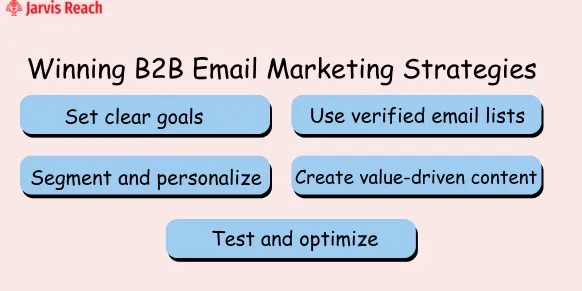
To succeed in today’s competitive landscape, you need structured, data-backed, and AI-enhanced B2B Email Marketing strategies. Here are the steps to build yours:
1. Be Clear About Objectives
Identify what success means to you: more signups, better engagement, higher conversions. Make sure and align your drip email campaigns to achieve the goals you are looking for from the outset.
2. Use Clean and Verified Lists
Your B2B email lists define the health of your campaign. Clean them regularly using validation tools to avoid bounces and spam complaints. Good list hygiene improves deliverability and overall email analytics performance.
3. Segment and Personalize
Segment based on B2B data, industry, company size, role, and behavior to enable better precision in outbound marketing and make every message personal and relevant.
4. Develop Engaging Content
Engaging content drives clicks. Make it educational, value-based, and aligned with buyer needs. Storytelling can be used to humanize your brand-even in B2B Email Marketing.
5. Test, Analyze, Repeat
Use email analytics to A/B test subject lines, visuals, CTAs, and send times. The numbers will identify the patterns you can use to increase sales and sharpen the future of your B2B Email Marketing strategies.
Importance of AI and Automation in B2B Email Marketing
The state of B2B Email Marketing is changing because AI is moving from a manual channel to a predictive, intelligent approach. AI can assist marketers and organizations with data-based decisions.
Key AI Contributions:
– Predicting best send times using engagement data.
– Creating customized content by applying marketing data patterns.
– Monitor the email analytics to help drive and create future campaigns.
– Enabling smarter drip email campaigns that adapt automatically.
This technology will keep your outbound marketing consistent and effective, while predictive insights help brands increase sales by understanding which messages convert.
Power of B2B Data and Marketing Data
In modern B2B Email Marketing, clean and reliable B2B data and marketing data are everything. Both determine campaign success from targeting and personalization to segmentation and automation.
· Collect ethically: employ forms, webinars, and lead magnets.
· Clean regularly: remove all duplicates and inactive contacts.
· Enrich logically: Add internal and third-party B2B data.
· Comply with laws: Follow GDPR and data protection guidelines.
Accurate B2B data empowers your B2B Email Marketing strategies to reach the right inboxes, personalize effectively, and continuously increase sales.
Outbound Marketing vs B2C Marketing
Although B2B Email Marketing and B2C marketing share similar tools, they differ in purpose and execution.
| Aspect | B2B Email Marketing | B2C Marketing |
| Target Audience | Businesses & professionals | Individual consumers |
| Goal | Relationship building & lead nurturing | Quick sales & emotional appeal |
| Tone | Professional, value-driven | Casual, emotion-based |
| Cycle | Longer, multi-step | Shorter, impulse-based |
| Content | Data, insights, case studies | Discounts, visuals, trends |
B2B Email Marketing generally generates better long-term ROI for brands aimed at outbound marketing.
Frequently Asked Questions (FAQs)
1. How can AI help improve B2B Email Marketing performance?
AI will improve email analytics by predicting engagement, optimally recommending drip email campaigns, and increasing sales based on findings from data.
2. What is the best way to prevent email blacklists?
Clean B2B email lists will help, use verified B2B data, and avoid spammy topics. Periodic list cleaning, as well as monitoring your sender reputation, will keep your outbound marketing healthy.
3. How to find verified B2B email addresses for free?
You could use LinkedIn for free, company websites, or some free enrichment tools that provide public marketing data. Always verify before adding to your B2B email lists.
4. What is email whitelisting and why is it important?
Whitelisting ensures your emails reach the inbox, not spam. Encourage subscribers to add you to a Safe Senders list, an important component of a successful B2B Email Marketing strategy.
5. What’s the difference between drip email campaigns and newsletters?
Drip email campaigns are an automated sequences that take a lead from awareness to nurture them over time, and email newsletters are more recent, focused on a unique idea or update that we tell the customer about. Either way, they both increase sales and engagement.
Conclusion: The Future of B2B Email Marketing
B2B Email Marketing will always be one of the most cost-effective and ROI-rich resources in today’s outbound marketing toolbox. With the ability to use AI, clean B2B data, and intelligent email analytics, it is easier than ever to create relationships that are meaningful and last.
The future lies in personalization and automation coupled with a sense of continuous learning. When businesses are armed with healthy B2B email lists, implement effective B2B Email Marketing strategies, and ultimately review every B2B email campaign for performance, they will create predictable growth and a consistent increase in sales. The key is, use B2B data to help make decisions, allow AI to drive optimal performance, and rely on human insight to create stories that motivate. And when done right, B2B Email Marketing does just that, it doesn’t just generate leads but establishes trust that lasts.
Jarvis Reach enables businesses to create high-performing B2B email marketing strategies with real-time insights, reliable marketing data, so every email makes an impact.

